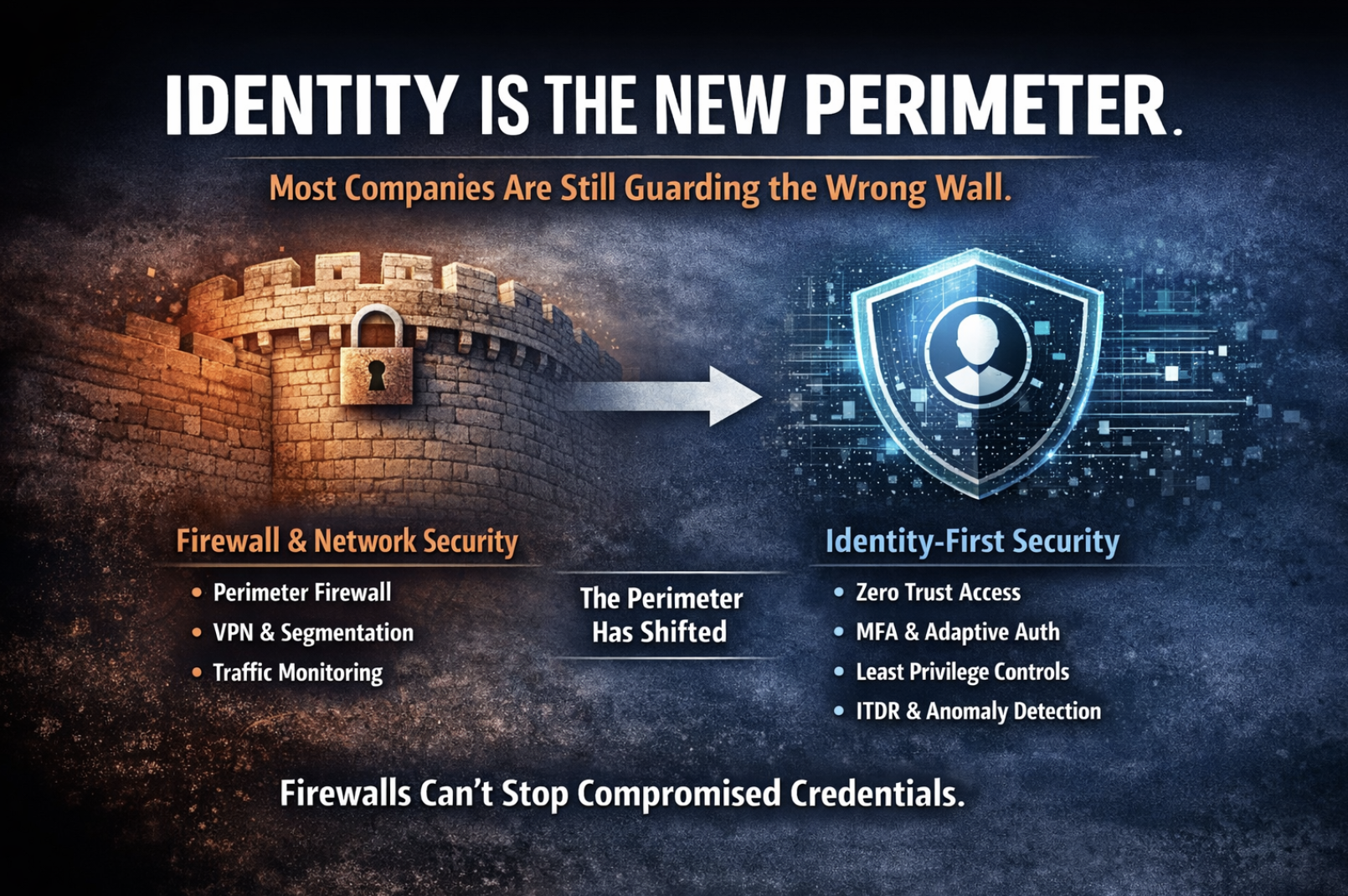

Identity is the new perimeter. And most companies are still guarding the wrong wall

CIS team
Firewalls don’t stop compromised credentials.
They never did.
A firewall evaluates packets. An identity system evaluates people, machines, service accounts, API tokens, and workload roles. In today’s security landscape, one of those is the enforcement plane that matters. The other is increasingly just traffic management.
Yet too many organizations are still spending like the network edge is where risk lives.
It isn’t.
The Perimeter Is Gone. The Identities Stayed.
There was a time when “inside” and “outside” were meaningful distinctions. Applications ran in a data center. Users were on corporate networks. VPNs created controlled tunnels. The perimeter was a physical and logical boundary.
That model collapsed quietly over the past decade:
- Infrastructure moved to AWS, Azure, GCP.
- Business units adopted SaaS without central governance.
- Contractors and partners gained system access.
- Remote work became permanent.
- Machine-to-machine traffic exceeded human logins.
- API keys and OAuth tokens replaced passwords in many workflows.
The attack surface didn’t shrink when we left the data center. It expanded.
And what persisted across every transition?
Identity.
User identities. Service identities. Application identities. Federated identities. Privileged identities.
The perimeter dissolved. The identities remained.
Today you can see this trend articulated across the industry — for example, in this recent discussion on why identity has become the control plane of modern security frameworks rather than network boundaries. Why identity has become the new security perimeter and why IAM now matters more than ever
Firewalls Don’t Fail. They’re Just Solving the Wrong Problem.
When an attacker logs in with valid credentials, your firewall performs exactly as designed — it allows the traffic.
When a developer’s API token is stolen from a CI/CD pipeline, the network stack doesn’t flag it. The request is authenticated.
When an admin account is phished and MFA is bypassed, the session is legitimate from a protocol standpoint.
Perimeter controls operate on origin and traffic patterns. Identity-based attacks operate on authorization context. Those are fundamentally different control planes.
The majority of material breaches today involve compromised credentials, token abuse, privilege escalation, or misconfigured identity roles — not brute-force network penetration. This is why Identity Threat Detection and Response (ITDR) has emerged as a distinct discipline focusing on continuous, identity-centric threat detection and remediation. Identity Threat Detection and Response explained by CrowdStrike
IAM Is Not an IT Function. It Is Risk Management.
Treating Identity and Access Management as a helpdesk operational artifact is strategically dangerous.
Every identity has:
- A scope of access
- A privilege tier
- A lateral movement potential
- A blast radius
That is not an IT ticket. That is enterprise risk exposure.
When a CFO’s credentials are compromised, that is financial risk.
When a DevOps service role is over-permissioned in production, that is operational continuity risk.
When SaaS access isn’t de-provisioned after departure, that is compliance and insider threat risk.
Identity isn’t about login experience. It’s about exposure control.
If your board is reviewing cyber risk in terms of firewall upgrades and endpoint agents — but not identity posture, privileged access distribution, and SaaS sprawl governance — they are reviewing the wrong dashboard.
IAM belongs in the risk register.
Cloud, SaaS Sprawl, and the Multiplication of Trust
Cloud did not simplify security. It abstracted infrastructure and multiplied identity dependencies.
In a modern enterprise you will find:
- 100+ SaaS applications
- Multiple cloud accounts
- Federated SSO connections
- Third-party integrations with OAuth grants
- Service accounts embedded in automation
- Human users with admin rights in at least one system
Each integration extends implicit trust.
The network no longer enforces boundaries. Identity does.
This shift is a core theme of how cloud-first organizations are reshaping security strategies — exemplified in frameworks such as CSA STAR, which emphasize identity governance and continuous assurance in cloud environments. How CSA STAR helps tackle modern cloud identity risks
Remote Work Made Identity Continuous
Remote work forced organizations to abandon location-based trust. IP allowlists and office segmentation became unreliable signals.
The replacement is contextual identity validation:
- Device posture
- Behavioral anomaly detection
- Risk-based authentication
- Continuous session monitoring
- Least privilege enforcement
Zero Trust architecture fundamentally embraces this — never trust, always verify. In practice, that means treating identity as the enforcement plane. Zero trust architecture explained (Wikipedia)
Authorization Is the Enforcement Layer
From a systems perspective, identity is the decision engine.
Authentication confirms who you are.
Authorization defines what you can do.
Governance ensures that authorization matches business intent.
If those layers are misaligned, the rest of your stack is irrelevant.
Over-permissioned roles, orphaned accounts, shadow SaaS admins, unmonitored service identities — these are architectural weaknesses, not operational oversights.
Most companies can tell you how many endpoints they manage.
Far fewer can tell you:
- How many privileged identities exist.
- Which service accounts have production write access.
- Where least privilege is violated.
- Which SaaS apps have stale OAuth grants.
- The mean time to detect anomalous identity behavior.
That data gap is the real exposure.
Identity-First Security: A Different Operating Model
Identity-first security is not a product category. It is a design principle.
It means:
- Access decisions are contextual and dynamic.
- Privilege is minimized and time-bound.
- Service accounts are treated as first-class attack vectors.
- Identity telemetry is monitored like network traffic once was.
- Risk scoring incorporates identity posture, not just vulnerability scans.
When identity becomes the perimeter, the enforcement point moves closer to the resource — not the network edge.
To understand why IAM is now more than authentication and authorization plumbing, you can review this industry take on why identity systems — even strong IdPs — are not enough by themselves. Identity Is the New Perimeter: Why Your IdP Isn’t Enough
The Wrong Wall
Many organizations are still reinforcing the outer wall — more appliances, more filters, more segmentation rules.
Meanwhile, identities move freely across cloud platforms, SaaS ecosystems, and remote environments with inconsistent governance.
You cannot firewall your way out of credential compromise.
Identity is now the control plane for access — and attackers know it. Recent reporting highlights how modern threats increasingly target SaaS and identity vectors as the weakest link in security postures. Inside the AI‑powered assault on SaaS: why identity is the weakest link (TechRadar)
Where CIS Fits
Identity-first strategies require architectural discipline, governance design, and ongoing monitoring — not just tool deployment.
A true identity-first advisor will:
- Map identity attack surfaces.
- Quantify privilege distribution.
- Implement least privilege across SaaS and cloud.
- Integrate ITDR into detection workflows.
- Align identity governance with enterprise risk reporting.
Security posture should be measured in controlled identities — not blocked IP addresses.